
New IFAB Rule: Players Face Red Cards for Covering Mouths During On-Field Confrontations
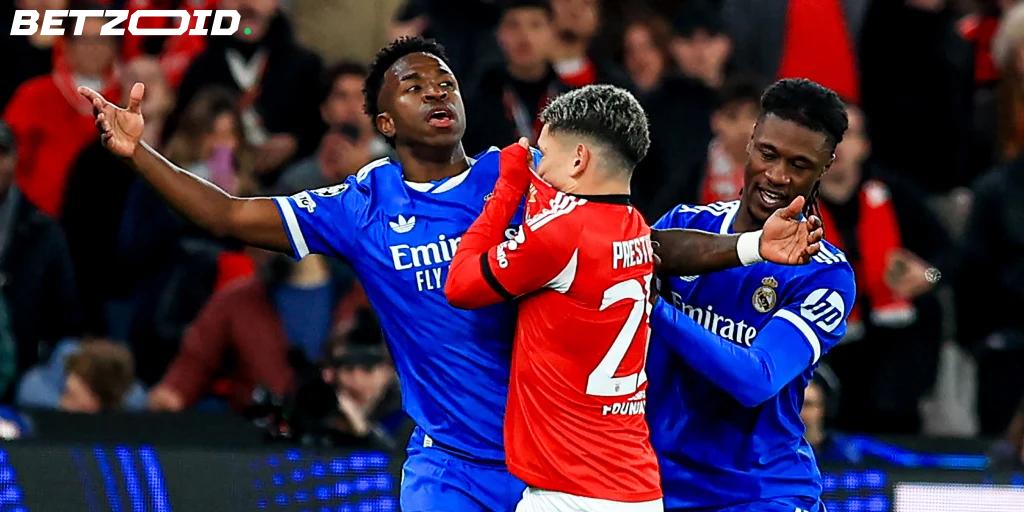
Cover your mouth during a heated exchange on the pitch? You're getting sent off. That's the new reality in football. The International Football Association Board has unanimously approved a rule requiring referees to issue red cards to any player who covers their mouth while confronting an opponent — a direct consequence of the February Champions League incident involving Real Madrid's Vinícius Júnior and Benfica's Gianluca Prestianni.
In the same session held in Canada, IFAB passed a second rule change: players who exit the field in protest of a referee's call will also face automatic expulsion. Both amendments represent significant shifts in how football addresses on-field behaviour.
The February incident that sparked change
Approximately 50 minutes into February's Champions League match, Vinícius found the back of the net and celebrated with his signature moves. Prestianni then approached the Brazilian forward with his jersey pulled over his mouth, and the two had a verbal exchange. Vinícius immediately went to the match official looking visibly upset, then made the crossed-arms gesture — the universal signal for alleged racist abuse. Play was halted and an investigation launched.
No disciplinary action occurred during the game itself. Following the match, Vinícius told the media that Prestianni had used a racial slur against him. Prestianni took to Instagram to deny the allegation, claiming Vinícius had "regrettably misunderstood what he thought he heard."
The situation escalated when Paris Saint-Germain's Kylian Mbappé provided witness testimony. "He said it five times," Mbappé stated unequivocally. "I am speaking as clearly as possible. I am telling you what I think and what I heard, and I heard it very well." This wasn't merely character support — it was direct eyewitness evidence that gave the incident undeniable credibility.
Prestianni's defence to UEFA officials took an unexpected turn: he admitted to using a homophobic slur rather than a racist one. UEFA subsequently issued him a six-match ban for homophobic discrimination. Since racist abuse carries a 10-match suspension, the distinction had significant legal and reputational implications.
Why IFAB made this decision
FIFA President Gianni Infantino explained the reasoning succinctly to Sky News: "There must be a presumption that he has said something he shouldn't have said, otherwise he wouldn't have had to cover his mouth." The logic is straightforward, though the rule's strict application will undoubtedly spark controversy.
Implementation presents legitimate challenges. Match officials already face intense pressure during live action. Determining whether a hand movement represents deliberate concealment or simply a habit will create grey-area situations. Teams that lose players to this rule during crucial knockout matches will likely contest the decisions.
Nevertheless, football faced an obvious problem and IFAB has provided a definitive solution. The Vinícius-Prestianni situation demonstrated how easily offensive language can be spoken on the pitch and subsequently denied without consequence. Bettors following World Cup group stage matches should take note — red card markets just became considerably more unpredictable.
Prestianni is currently serving his six-match UEFA suspension. Vinícius, meanwhile, never received a conclusive answer about what was actually said to him that evening in Lisbon.